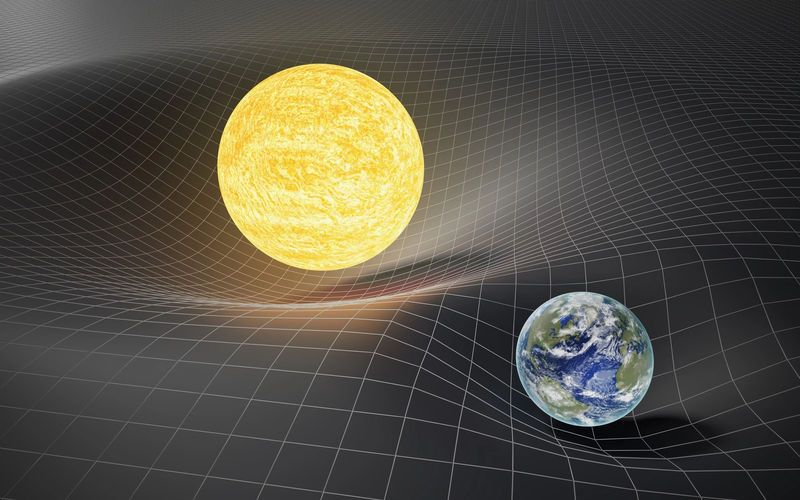
What is gravity or how does gravity work?
While Sir Isaac Newton is famous for formulating the Universal Law of Gravitation in 1687, the concept of gravity as an attractive force was recognized by scientists and philosophers centuries before him.
The Earliest Known Conceptual Discoveries (Pre-Newton):
- 7th Century (India): Astronomer Brahmagupta is credited with first proposing that gravity is an attractive force. In 628 CE, he stated that "all heavy things fall down to earth by a law of nature" and described it as a force inherent to the planet.
- 11th/12th Century (Persia/India): Scholars like Abu Rayhan al-Biruni and Bhaskaracharya expanded on this. Bhaskaracharya (1114–1185) explicitly stated in his treatise Siddhanta Shiromani that the earth attracts objects towards it.
- 300s BC (Greece): Aristotle introduced a primitive concept of "natural motion" or "gravitas" arguing that heavy objects fall toward their "natural place" which he believed was the center of the universe.
What Newton Actually Discovered:
Newton is credited with the first mathematical, universal theory of gravity. Rather than just observing that things fall, he proved:
- Universality: Gravity applies to all objects in the universe, not just on Earth (i.e., the moon is "falling" around the Earth).
- The inverse-square law for gravity is most famously known as Newton's law of universal gravitation . The formula is: $$ F = G \frac{m_1 m_2}{r^2} $$
- Where:
- \(F\) is the force of gravity between two objects.
- \(G\) is the gravitational constant.
- \(m_1\) and \(m_2\) are the masses of the two objects.
- \(r\) is the distance between the centers of the two objects.
- Where:


