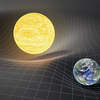
Key Historical Developments of Gravity
The Role of Gravity
Gravity is the force that pulls objects toward the Earth. Near the Earth’s surface, all objects experience the same acceleration due to gravity, which is approximately 9.8 m/s². This means that, in ideal conditions, all objects speed up at the same rate as they fall.
Ignoring Air Resistance
If we ignore air resistance (friction from the air), both the 10 kg and 50 kg objects will fall at exactly the same speed and hit the ground at the same time. This is because gravity affects all masses equally.
This idea was famously demonstrated by Galileo, who showed that objects of different masses fall at the same rate when air resistance is negligible.
The Effect of Air Resistance
In real-world conditions, air resistance plays a role. Air pushes against falling objects and slows them down. Lighter objects are usually affected more because they have less weight compared to the force of the air.
In this case:
- The 50 kg object experiences a stronger gravitational force.
- Air resistance has less impact on it relative to its weight.
- The 10 kg object may slow down slightly more.
As a result, the heavier object might reach the ground just a tiny bit earlier.
Real-Life Example
If both objects are compact and similar in shape (like two metal balls), the difference in falling time from 100 meters is extremely small-almost unnoticeable.
However, if one object has a much larger surface area (like a feather or a sheet of paper), air resistance becomes significant, and it will fall much slower.
How do i experiment air resistance so as to find it?
Experimenting with air resistance lets you see how it affects falling objects. Since you’re interested in finding or measuring air resistance, here are a few hands-on experiments you can try, ranging from simple observations to more quantitative methods.
1. Simple qualitative experiment (see the effect)
What you need:
- Two sheets of paper (same size)
- One flat sheet, one crumpled into a tight ball
Steps:
- Drop the flat sheet and the crumpled ball from the same height at the same time.
- Observe which lands first.
Why it works:
Both have the same mass, but the flat sheet has more surface area facing downward → more air resistance → falls slower.
The crumpled ball has less area → less air resistance → falls faster.
What you “find”:
You see that air resistance depends on the object’s shape and cross-sectional area.
- Measuring drag force with a spring scale (static method)
This measures air resistance indirectly at terminal velocity.
What you need:
- Spring scale (0–5 N or more)
- Small object (e.g., a plastic ball or coffee filter)
- Fan (to create airflow)
Steps:
- Hang the object from the spring scale in still air → record weight (force due to gravity).
- Turn on a fan so air flows upward past the object.
- Read the spring scale again. It will show less force because air resistance pushes upward.
- Air resistance \( F_{\text{air}} = \text{Weight} - \text{Scale reading in airflow} \).
What you “find”:
The upward air resistance force at a given airspeed.
- Coffee filter drop experiment (quantitative with timing)
What you need:
- Several coffee filters (identical, nestable)
- Stopwatch
- Meter stick or measuring tape (height ~2 m)
- Scale
Steps:
- Measure mass of 1 filter, 2 stacked, 3 stacked, etc.
- Drop each stack from the same height (e.g., 2 m) and time the fall.
- Calculate average fall speed: \( v = \frac{\text{height}}{\text{time}} \).
Analysis:
At terminal velocity (constant speed), air resistance \( F_{\text{air}} = m g \).
So for each stack:
\[F_{\text{air}} = (\text{mass of stack}) \times g\]
And since \( F_{\text{air}} \) depends on speed \( v \), you can plot \( F_{\text{air}} \) vs. \( v \) to see if air resistance is proportional to \( v \) (low speeds) or \( v^2 \) (higher speeds).
- Drop from a height with video analysis (more accurate)
What you need:
- Smartphone with slow-motion video (240 fps or higher)
- Meter stick in frame for scale
- Object of known mass (tennis ball, small dense ball, and a light large object like a balloon or paper plate)
Steps:
- Record the fall from ~2 m height.
- Use video analysis software (e.g., Tracker, Vernier Video Physics, or even manual frame-by-frame) to measure position every few frames.
- Plot position vs. time → get velocity vs. time.
- Compare acceleration to \( g \). The difference is due to air resistance.
Finding air resistance:
From Newton’s 2nd law:
\[mg - F_{\text{air}} = m a\]
\[F_{\text{air}} = m(g - a)\]
At each moment, \( a \) is from the velocity-time graph slope.
- Using a fan and motion sensor (lab setup)
What you need:
- Motion sensor (like from a physics lab kit)
- Fan with adjustable speed
- Light object on a low-friction track or hanging vertically
Steps:
- Mount object so motion sensor can measure its acceleration under airflow.
- Measure acceleration with fan off (just gravity, or zero if horizontal).
- Turn fan on to apply air resistance force.
- Use \( F_{\text{air}} = m a_{\text{total}} \) (accounting for other forces).
How to Calculate Gravity: A Complete Derivation from Motion
Small Description
"How to Calculate Gravity" is a step-by-step guide to determining the acceleration due to gravity (\(g\)) using only measurements of distance and time — without assuming any prior knowledge of gravitational theory. Starting from the fundamental definitions of position, velocity, and acceleration, we use calculus to derive the free-fall equation \(h = \frac{1}{2}gt^2\). Then, by measuring how far an object falls in a known time, we calculate \(g\). This approach mirrors how scientists like Galileo first discovered and measured gravity experimentally.
Complete Derivation
We start from scratch: distance, velocity, and acceleration — building up to the free-fall equation using calculus , step by step, with every formula clearly explained.
We assume nothing except the definitions of motion.
Step 1: Position as a function of time
Let \( h(t) \) be the height (position) of an object at time \( t \).
- Units: height in meters (m), time in seconds (s)
Step 2: Definition of velocity
Velocity is the rate of change of position with respect to time.
In calculus:
\[v(t) = \frac{dh}{dt}\]
- If \( v > 0 \), the object is moving upward.
- If \( v < 0 \), the object is moving downward.
Units: \( \text{m/s} \)
Step 3: Definition of acceleration
Acceleration is the rate of change of velocity with respect to time.
\[a(t) = \frac{dv}{dt} = \frac{d^2h}{dt^2}\]
- If \( a > 0 \), velocity is increasing.
- If \( a < 0 \), velocity is decreasing.
Units: \( \text{m/s}^2 \)
Step 4: Constant acceleration assumption
For free fall near Earth's surface (ignoring air resistance), acceleration is constant .
We call that constant \( g \), but initially we don't know its value.
\[a(t) = g \quad \text{(constant)}\]
So:
\[\frac{dv}{dt} = g\]
Step 5: Integrate to find velocity
Integrate both sides with respect to \( t \):
\[\int \frac{dv}{dt} \, dt = \int g \, dt\]
\[v(t) = g t + C_1\]
Here, \( C_1 \) is the initial velocity at \( t = 0 \):
\[v(0) = C_1\]
If the object starts from rest :
\[v(0) = 0 \implies C_1 = 0\]
Thus:
\[v(t) = g t\]
Step 6: Integrate again to find position
We know:
\[v(t) = \frac{dh}{dt} = g t\]
Integrate both sides:
\[\int \frac{dh}{dt} \, dt = \int g t \, dt\]
\[h(t) = g \cdot \frac{t^2}{2} + C_2\]
\[h(t) = \frac{1}{2} g t^2 + C_2\]
Here, \( C_2 \) is the initial position at \( t = 0 \):
\[h(0) = C_2\]
If we measure height from the release point :
\[h(0) = 0 \implies C_2 = 0\]
Thus:
\[h(t) = \frac{1}{2} g t^2\]
Step 7: The full set of motion equations (constant acceleration)
For constant acceleration \( a \), initial velocity \( v_0 \), initial position \( h_0 \):
For our free-fall case:
\[a = g, \quad v_0 = 0, \quad h_0 = 0\]
\[\boxed{h(t) = \frac{1}{2} g t^2}\]
Step 8: Relating velocity and position without time
Sometimes we don't know \( t \). We can eliminate \( t \):
From \( v = v_0 + a t \), we get \( t = \frac{v - v_0}{a} \).
Substitute into \( h = h_0 + v_0 t + \frac{1}{2} a t^2 \):
After algebra:
\[v^2 = v_0^2 + 2a (h - h_0)\]
For free fall from rest (\( v_0 = 0, h_0 = 0 \)):
\[v^2 = 2 g h\]
Step 9: How to calculate \( g \) — the actual measurement
From \( h = \frac{1}{2} g t^2 \), solve for \( g \):
\[g = \frac{2h}{t^2}\]
Experimental procedure:
- Drop an object from rest.
- Measure the distance fallen \( h \) (in meters).
- Measure the time \( t \) (in seconds) it takes to fall that distance.
- Plug into \( g = 2h / t^2 \).
Numerical example:
Suppose we drop a ball from rest and measure \( h = 4.9 \, \text{m} \) after \( t = 1 \, \text{s} \):
\[4.9 = \frac{1}{2} g (1)^2\]
\[4.9 = \frac{g}{2} \implies g = 9.8 \, \text{m/s}^2\]
We just measured \( g \) — no Newtonian gravity needed. Just distance, time, and calculus.
Step 10: Summary of calculus relationships
For constant acceleration , these integrals give polynomials:
\[\begin{aligned} a(t) &= a \\ v(t) &= \int a \, dt = a t + v_0 \\ h(t) &= \int (a t + v_0) \, dt = \frac{1}{2} a t^2 + v_0 t + h_0 \end{aligned}\]
Final Boxed Result — The Formula to Calculate Gravity
\[\boxed{g = \frac{2h}{t^2}}\]
Where:
- \( g \) = acceleration due to gravity (in m/s²)
- \( h \) = distance fallen (in meters)
- \( t \) = time of fall (in seconds)
And the motion equation:
\[\boxed{h = \frac{1}{2} g t^2}\]
This is pure kinematics — the mathematics of motion. Gravity only enters through the measured value of \( g \).
Key Insight
You don't need Newton's law of gravitation (\( F = G\frac{m_1 m_2}{r^2} \)) to calculate \( g \). You only need:
- A ruler (to measure \( h \))
- A stopwatch (to measure \( t \))
- Basic calculus (to derive \( h = \frac{1}{2}gt^2 \))
That's it. This is how gravity was first measured - and how you can discover it yourself.
Next step: Connect this measured \( g \) to Newton's law of gravitation, then to the Einstein field equations.